


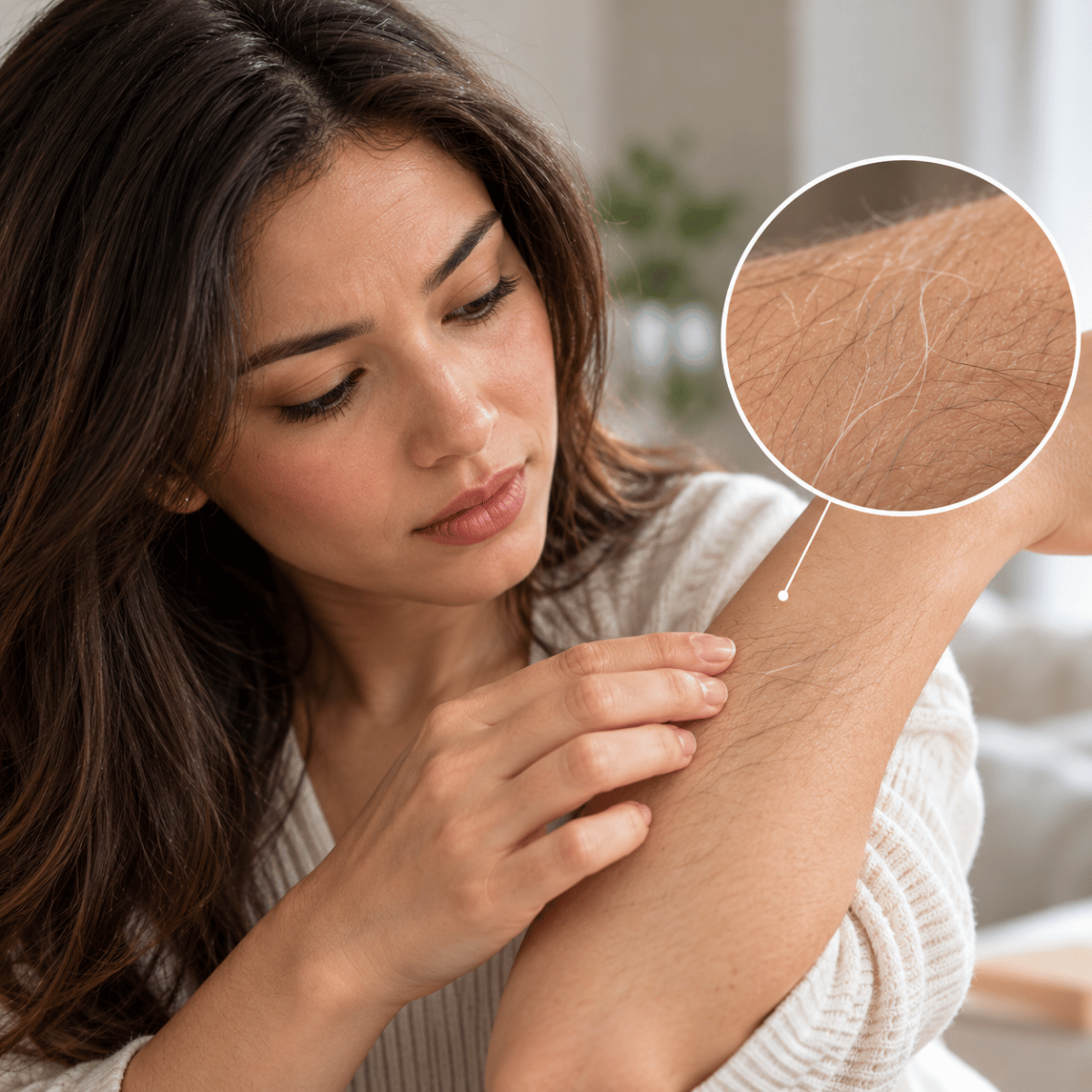
Can IPL Turn Your Hair White? The Facts on Leukotrichia

Can IPL turn your hair white? You treated an area with intense pulsed light (IPL), and now a few hairs are coming through white. Worrying about that is reasonable. The medical literature does describe hair whitening after IPL, known as leukotrichia, but the evidence is limited and comes from professional treatment rather than at-home devices. This guide covers what leukotrichia means, what the research found and what to do if your hair colour changes
Can IPL Turn Your Hair White?
It has been reported. A 2002 clinical study of professional IPL hair removal documented leukotrichia in a group of patients, and a 2026 review of follicular depigmentation lists IPL among the procedures associated with it, citing that same study.
That is the limit of what the evidence supports. No one has established how often it happens across devices and treatment settings. A white hair that appears after a session does not prove the light caused it, because hair loses colour for many reasons. Findings from professional systems also cannot be read as the risk for an at-home device.
What Is Leukotrichia?
Leukotrichia is hair that has lost its melanin, the pigment that gives hair its colour, so it looks white. It can show up as single hairs or small patches, on the scalp, brows, beard or body.
The word describes what you can see, not why it happened. The 2026 review calls it a descriptive term rather than a diagnosis. Causes include inherited conditions, autoimmune and inflammatory conditions such as vitiligo and alopecia areata, certain medicines, and injury to the follicle from procedures including IPL and laser. Telling these apart takes a clinician, not a close look at the hair.
How Could IPL Affect Hair Pigment?
IPL light is absorbed by melanin and converted into heat, which is how it targets pigmented hair. Melanocytes, the follicle cells that make melanin, sit close to that heat.
The authors of the 2002 study proposed that this heat may impair the pigment-producing melanocytes without necessarily destroying the cells involved in hair growth. This remains a proposed explanation. The available evidence does not establish the mechanism in every reported case.
What Does the Research Say About IPL-Induced Leukotrichia?

A clinical study reported hair whitening after IPL
Radmanesh and colleagues, writing in Dermatologic Surgery in 2002, treated 821 patients for unwanted hair between February 2001 and February 2002. They used a professional non-coherent IPL system with a 650 nm filter, treating monthly with settings adjusted to skin type. Leukotrichia developed in 29 patients.
Thirteen of those 29 had no white or grey hairs before treatment. The other 16 had a few white hairs and reported that new ones appeared faster after the first or second session. Colour returned in nine patients. The other 20 had no improvement over the following two to six months.
Several limits apply:
It tested one professional system, not a modern consumer device.
Treatment settings and patients cannot be assumed to match home use.
The report covers treated patients and offers no untreated comparison, so it cannot show how many would have developed white hairs anyway.
29 of 821 is not an incidence figure for IPL in general, and it cannot tell any individual their likelihood.
What can we conclude about at-home IPL?
Leukotrichia after IPL is a documented possibility. Neither source gives a reliable risk figure for any specific at-home device, and the 29 in 821 should not be carried over to Ulike or any other consumer product. The available evidence does not establish how likely this outcome is with at-home IPL.
Is Hair Whitening After IPL Permanent?
Whether hair colour returns depends on the underlying cause, and the available IPL evidence cannot predict the outcome for an individual. In the 2002 study, nine patients regained colour, while 20 had no improvement during the two-to-six-month follow-up. These results do not establish long-term outcomes. Nobody can promise that white hairs will darken, and nothing here shows that every case is permanent.
How Is Leukotrichia Different From Natural Greying?
Feature |
Natural greying |
Possible treatment-associated leukotrichia |
Meaning |
Hair progressively loses pigment as part of the greying process |
Hair loses pigment in a pattern or timeframe that may be linked to a treatment |
Pattern |
Often gradual and diffuse, though patterns vary |
May involve single hairs or a more localised area |
Cause |
Commonly linked to age, genetics and changes in follicular pigment production |
Several possible causes; timing after IPL does not prove causation |
Assessment |
Often gradual, but appearance alone cannot establish the cause |
New, unexpected or localised changes may warrant clinical assessment |
What Should You Do If Your Hair Turns White After IPL?

Pause treatment on that area. Do not increase the intensity or frequency, or continue treating in an attempt to reverse the colour change. White hair also gives IPL little to work with, as our guide on whether IPL works on grey and white hair explains.
Check your device instructions. Read the guidance for your specific Ulike device on the how-to-use page, and contact Ulike UK support if it does not cover the change you have noticed. Do not increase the intensity or resume treatment on the affected area simply because the skin feels normal. The standard patch-test procedure is not a guarantee against hair pigment changes.
Document the change. Record when you noticed it, the treatment area, the device and mode, and the dates of recent sessions. Photographs help show progression.
Seek advice from a GP or dermatologist if the change is new, persistent or unexplained, particularly if you also notice patches of lighter skin, inflammation or other symptoms. A clinician can assess whether the change may be related to IPL or another cause.
Do not assume IPL is the cause. A clinician can assess the pattern and your history.
Can You Prevent Leukotrichia From IPL?
No precaution has been shown to prevent it, so no one can honestly promise protection. You can reduce avoidable risks by following the official Ulike UK device instructions for skin and hair suitability, treatment intervals and intensity.
Do not treat more often or at a higher setting than directed. A patch test checks how your skin reacts, not whether hair pigment will change. If something unexpected happens, stop and get advice. For wider safety information, see our guide to common mistakes that cause IPL side effects.
Frequently Asked Questions
Can IPL make dark hair turn white?
It has been reported in the medical literature, but the evidence is limited. It does not show how likely this is with modern home-use devices.
Will white hairs after IPL turn dark again?
Sometimes. Nine of the 29 patients in the 2002 study regained colour, while 20 had no improvement during follow-up. Individual outcomes cannot be predicted from that study.
Is leukotrichia the same as grey hair?
No. Both involve less pigment, but leukotrichia is a descriptive term for depigmented hair with several possible causes, while natural greying is a common age- and genetics-linked process.
Does at-home IPL carry the same risk as professional IPL?
The evidence does not say. The study tested one professional system, so it cannot estimate the risk for any consumer device.
Should I stop using IPL if I notice new white hairs?
Pause treatment on the affected area, check the device guidance and see a GP or dermatologist if the change is unexplained or persistent.
Conclusion
Leukotrichia after IPL has been reported, but the available research cannot establish the risk for modern at-home devices. If you notice unexpected hair whitening after treatment, pause use on the affected area and seek medical advice if the change is persistent or unexplained. For more, read our guides on IPL side effects and IPL on grey and white hair.
Ulike Air 3 Deluxe Set: What’s Included and Is It Worth It?
Can IPL Turn Your Hair White? The Facts on Leukotrichia

IPL Before a Holiday: How Far in Advance Should You Start?
Explore Beauty
Ulike Air 10
2 weeks to silky smooth skin.
96% Hair Density Reduction in 4 Weeks
Ulike Air 10 Deluxe
10-minute full-body sessions
96% Hair Density Reduction in 4 Weeks
Ulike 2 Max
Gentle on sensitive skin
94.5% hair reduction in 4 weeks*
Ulike Reglow
Clearer skin in 2 weeks: Fewer breakouts
Smoother skin in 4 weeks: Fewer lines, firmer feel
JMOON by Ulike M12 Max (RD)
Lift, Firm, and Smooth Your Skin With One Device